
Preparing for High-Pressure Moments (Without Trying to Eliminate Anxiety)
High-pressure moments place unique demands on both mind and body. Whether it’s a race, performance, exam, presentation, or critical conversation, these situations often involve uncertainty, evaluation, and connection to what matters.
For many people, the goal becomes reducing anxiety before these moments arrive. Yet attempts to eliminate anxiety often increase internal pressure and make performance less reliable rather than more so.
Preparing for high-pressure moments is less about feeling calm, and more about supporting the nervous system to function effectively when demand is high.
Why anxiety isn’t the problem
Anxiety is a natural response to perceived importance or demand. When something matters, the nervous system mobilises energy to support focus, readiness, and effort.
Difficulties arise not because anxiety is present, but because the system shifts too far into threat. When this happens, attention narrows, physiological tension increases, and access to flexible thinking reduces.
Trying to eliminate anxiety often sends a contradictory message to the nervous system — that the situation is dangerous and must be controlled — which can intensify arousal rather than settle it.
From a nervous-system perspective, the aim is not calmness, but regulation.
Preparing the nervous system, not just the mind
Preparation is often framed as mental rehearsal or cognitive preparation. While these approaches can be helpful, they are most effective when paired with physiological support.
Nervous-system-informed preparation focuses on:
familiarity rather than certainty
steadiness rather than confidence
capacity rather than control
When the system recognises a situation as challenging but manageable, it is more likely to remain flexible under pressure.
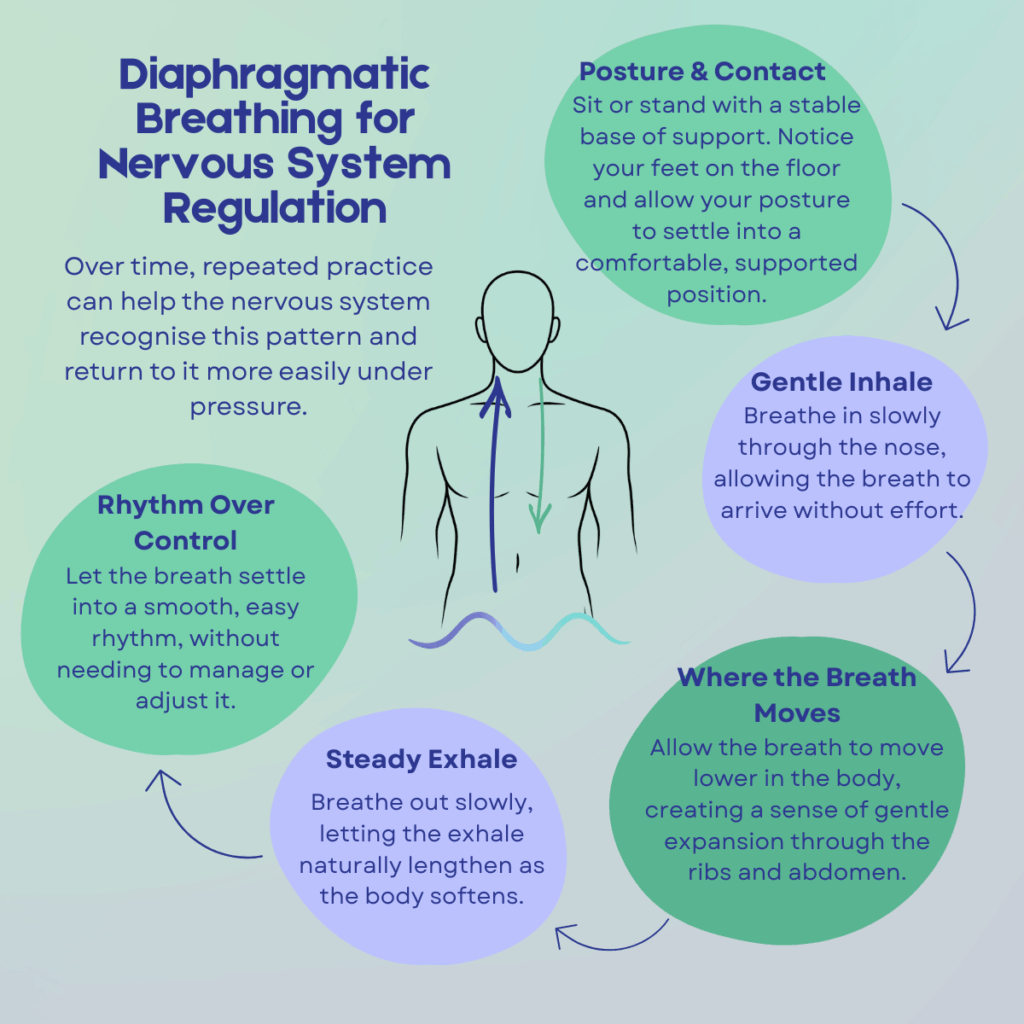
Preparing for high-pressure moments involves supporting the nervous system as well as the mind. Slow, steady breathing patterns can help shift the system toward steadiness by reducing unnecessary threat activation. The diagram below outlines a simple diaphragmatic breathing pattern that can be practised over time to support regulation under pressure.
The diagram below outlines a simple diaphragmatic breathing pattern. A printable version with a little more guidance is available to download by clicking on the button below.
What effective preparation looks like under pressure
Preparing for high-pressure moments involves building conditions that allow the system to settle into a workable range of arousal.

Building familiarity
The nervous system responds more effectively to situations it recognises. Familiarity reduces unnecessary threat activation.
This might involve:
practising under conditions that resemble performance demands
rehearsing transitions (e.g., waiting, starting, responding)
becoming familiar with bodily sensations associated with arousal
The goal is not to remove discomfort, but to reduce surprise.
Supporting regulation before the moment
Regulation strategies are most effective when practised outside of pressure.
Helpful supports may include:
slow, steady breathing patterns
grounding through movement or posture
consistent pre-performance routines
These approaches help the system return to baseline more efficiently when arousal increases.
Allowing anxiety without escalation
When anxiety is treated as something that must be removed, the nervous system often responds by increasing tension and vigilance. This reflects a protective response to situations that matter, rather than a sign that something is wrong.
Allowing anxiety to be present, without attempting to suppress or fix it, can reduce secondary threat responses and support clearer attention and more consistent effort during the task itself.
For many people, this escalation is amplified by harsh internal dialogue or self-critical thinking patterns, which can further narrow attention and undermine performance. You can read more about how self-criticism interacts with pressure and performance here…
In-the-moment regulation
Even with preparation, arousal may rise sharply once a high-pressure moment begins. What matters then is not control, but response.
In-the-moment regulation often involves:
orienting attention to the task rather than outcomes
noticing physiological cues without reacting to them
gently returning focus when attention narrows
Small, repeatable anchors, such as breath, rhythm, movement, or pacing, can support the nervous system to remain engaged without becoming overwhelmed.
Performance is shaped before the moment arrives
Performance under high pressure is rarely determined by what happens in the moment alone. It is shaped by how the body and mind have learned to respond to pressure over time, through repeated experiences of challenge, uncertainty, and effort.
When preparation builds familiarity with arousal, supports regulation, and includes realistic expectations about anxiety, pressure is more likely to be experienced as challenging rather than overwhelming. From here, it becomes easier to stay engaged with the task itself – pacing effort, responding to cues, and adjusting as needed – rather than becoming caught in protective responses such as excessive tension, over-monitoring, or withdrawal.
While preparation that focuses on familiarity, regulation, and realistic expectations supports flexibility under pressure, it is most effective when guided by a clear sense of what the effort is in service of. Preparation that is anchored in meaning, rather than solely in outcomes or avoidance of failure, provides a more stable point of reference when pressure increases.
Preparing for meaning, not just execution

While this article has focused on preparation and regulation, high-pressure moments are also shaped by why something matters.
When performance is closely linked to identity, values, or self-worth, anxiety often intensifies. In these situations, preparation that focuses only on execution – skills, routines, or regulation – can leave the system more vulnerable when outcomes feel personal or consequential.
Preparation that is anchored in meaning provides an additional layer of support. When effort is connected to values rather than solely to outcomes or avoidance of failure, pressure is less likely to destabilise attention and engagement.
The next article in this series explores how values, performance, and anxiety interact, and how anchoring performance in values can support steadiness and persistence when pressure is unavoidable.
Closing reflections
Preparing for high-pressure moments doesn’t require eliminating anxiety or forcing calm. It involves learning how to support the nervous system to respond effectively when demand is high.
With practice over time, preparation becomes less about control and more about capacity, allowing performance to unfold with greater consistency, flexibility, and resilience.
Next steps and support
If high-pressure situations are shaping your wellbeing or performance, support is available. A nervous-system-informed performance psychology approach can help explore how anxiety, attention, and preparation interact across sporting, professional, and other performance contexts.
